Covent Garden stands as one of London's most remarkable urban transformations. What began as a walled garden for Westminster Abbey monks has evolved over four centuries into the beating heart of the capital's cultural district.
From Sacred Ground to Aristocratic Estate
The area's story begins around 600 AD, when it formed the centre of Lundenwic, an Anglo-Saxon trading settlement stretching from Trafalgar Square to Aldwych. By 1200, the land had become a walled garden owned by the Benedictine monks of Westminster Abbey. Documents from 1250 to 1283 refer to it as "the garden of the Abbot and Convent of Westminster"—the origin of its enduring name.
The first recorded use of "Covent Garden" appeared in 1515, deriving from the Anglo-French term for a religious community. The Dissolution of the Monasteries in 1540 brought the land back to the Crown, and in 1552, King Edward VI granted it to John Russell, 1st Earl of Bedford.
In 1630, Francis Russell, 4th Earl of Bedford, commissioned architect Inigo Jones to design a new kind of London development: a piazza surrounded by houses with a church at its centre. Construction of St Paul's Church began in July 1631 and completed in 1633 at a cost of £4,886. The last house in the piazza was finished in 1637, creating London's first modern square and establishing a prototype that would influence later estates across the city, including Ladbroke and Grosvenor.
The Rise of a Market
By 1654, traders had begun setting up stalls against Bedford House garden wall, creating what records describe as a "new market in Covent Garden." In 1670, the Earl of Bedford secured a private charter from Charles II to hold a fruit and vegetable market daily except Sundays and Christmas Day.
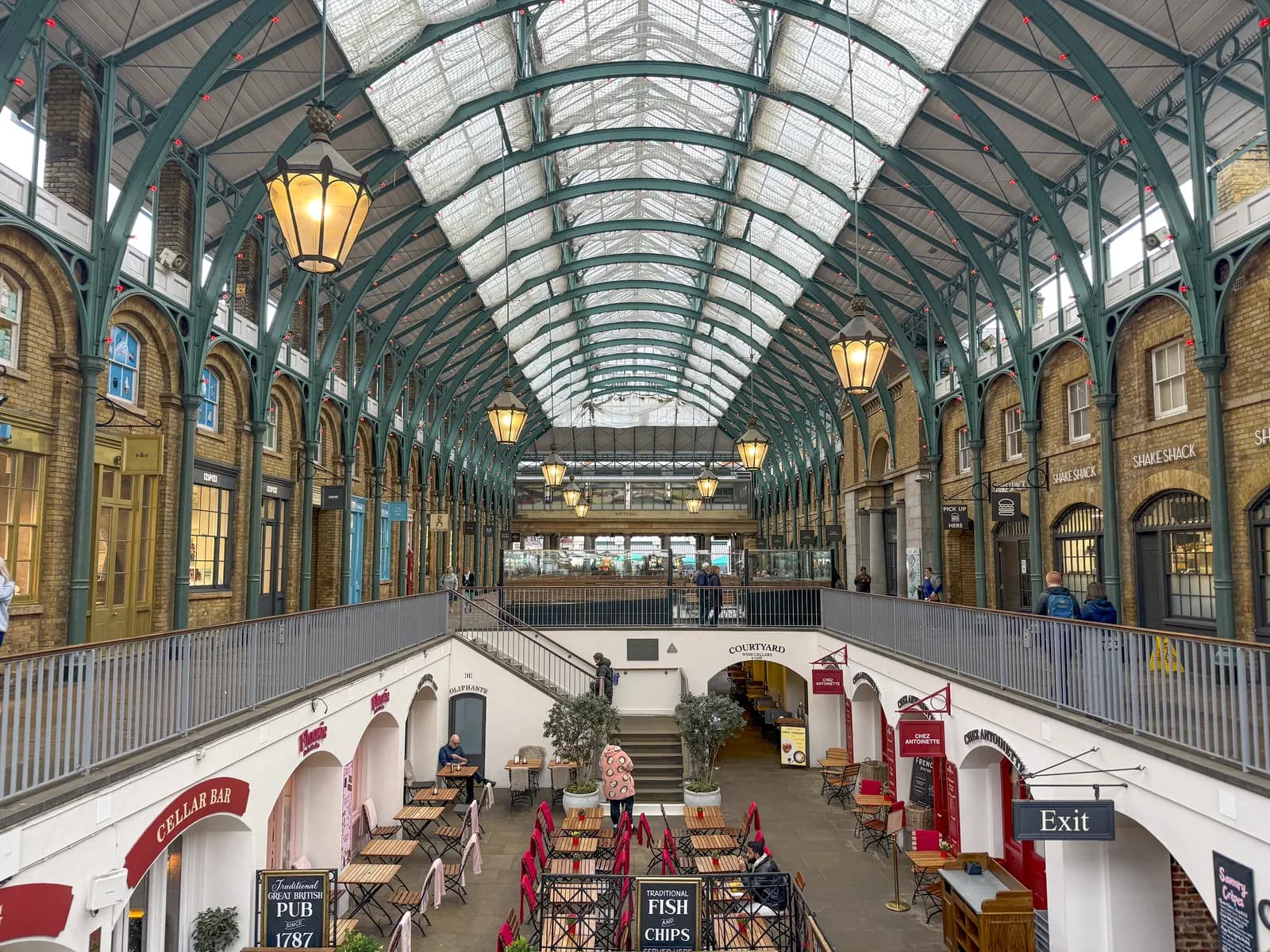
The market's significance grew throughout the 18th and 19th centuries. The Covent Garden Market Act of 1813 formalised its regulation, and in 1830, Charles Fowler designed the neo-classical market building that still defines the area's architectural character today. Constructed by William Cubitt and Company, the building featured granite pillars quarried from Cairngall in Aberdeenshire.
The market continued to expand, with the Jubilee Market for foreign flowers added in 1904. However, by the 1960s, traffic congestion had made the central London location increasingly problematic. In 1962, the Covent Garden Authority purchased the properties for £3,925,000, and in 1974, the wholesale market relocated to New Covent Garden Market at Nine Elms in Battersea.
Theatre and Performance Heritage
Covent Garden's theatrical credentials run deep. The Theatre Royal in Drury Lane opened on 7 May 1663 under letters patent from Charles II, making it London's oldest working theatre site. The current building, opened in 1812 and designed by Benjamin Dean Wyatt, remains Grade I listed and seats 1,996.
The Royal Opera House traces its origins to 7 December 1732, when John Rich opened the Theatre Royal with William Congreve's "The Way of the World." Rich had financed the venture using capital from "The Beggar's Opera." The first ballet, "Pygmalion," was presented in 1734, and George Frideric Handel began his first season of operas in 1735, premiering many works written specifically for Covent Garden.
Fire twice destroyed earlier theatres on the site, in 1808 and 1856. The current building opened on 15 May 1858, designed by Edward Middleton Barry with Lucas Brothers as builders. The main auditorium now seats 2,256. The Royal Opera began at Covent Garden in 1945, followed by the Royal Ballet in 1946, which reopened the theatre with "The Sleeping Beauty" on 20 February 1946. A £178 million reconstruction in the 1990s secured its position as a world-class venue.
The Actors' Church
St Paul's Church, completed in 1633, earned the nickname "The Actors' Church" through its centuries-long association with the theatre community. The first Punch and Judy performance recorded in England took place under its portico on 9 May 1662, documented by Samuel Pepys. The church holds memorials to Charlie Chaplin, Sir Noël Coward, Dame Ellen Terry, and Dame Edith Evans, among others. Notable baptisms include J.M.W. Turner and Sir William S. Gilbert of Gilbert and Sullivan fame.
Modern Transformation
The market's closure in 1974 marked the beginning of a new chapter. On 28 March 1980, the central building reopened as a shopping centre, with the London Transport Museum occupying the former flower market building designed by William Rogers in 1871. The museum underwent a £22 million refurbishment between 2005 and 2007, reopening on 22 November 2007. It now attracts 449,599 visitors annually.
In 2006, Capital & Counties Properties (now Shaftesbury Capital) acquired the market buildings for £421 million on a 150-year head lease. Today, the Covent Garden Estate encompasses 550,000 square feet with a market value of £2.7 billion. The buildings are let to the Covent Garden Area Trust for an annual peppercorn rent of one red apple and a posy of flowers.
The central hall now houses shops, cafés, bars, and the Apple Market, where vendors sell antiques, jewellery, clothing, and gifts. Street performers audition for allocated slots, continuing a tradition of public entertainment that dates back centuries. In 2010, the world's largest Apple Store opened in the piazza.
Local Connections
Covent Garden tube station opened in 1907 on the Piccadilly line. The 300-yard journey from Leicester Square represents the shortest distance between any two stations on the London Underground network. The area remains home to approximately 7,000 residents, even as millions of visitors pass through annually.
What began as a simple walled garden has, across four centuries, transformed into one of London's most vibrant cultural destinations. From monastic produce to theatrical premieres, from wholesale vegetables to high-end retail, Covent Garden's evolution mirrors London's own capacity for reinvention while preserving its architectural and cultural heritage.