The Fire That Changed London Forever
On Sunday 2 September 1666, a fire broke out in Thomas Farriner's bakery in Pudding Lane. By the time it was extinguished four days later, the medieval City of London lay in ruins.
The blaze consumed approximately 13,200 houses, 87 parish churches, St Paul's Cathedral, and the majority of the City companies' halls. The flames spread from within the old Roman walls westwards, leaving behind a charred landscape that would take decades to rebuild. The death toll remains disputed, though most historians consider it relatively small given the scale of destruction.
Contemporary diarist John Evelyn described the scene on 3 September: "The conflagration was so universal, and the people so astonished, that from the beginning, I know not by what despondency or fate, they hardly stirred to quench it." Samuel Pepys, witnessing the chaos from the Thames, recorded desperate Londoners flinging their possessions into the river or fleeing into boats as the flames approached.
A Scientific Mind Turns to Architecture
Before the fire, Christopher Wren had established himself as a scientist, astronomer, and mathematician. His academic career at Oxford focused on physics and astronomy, with architecture initially little more than a secondary interest.
The devastation of 1666 would redirect his talents permanently. In 1669, Wren was appointed Surveyor of the King's Works, and on 30 July that year he was formally assigned responsibility for designing the new St Paul's Cathedral. The king also commissioned him to design 51 replacement churches for the 88 parish churches lost to the flames.
Parliament had already acted to enable reconstruction. The Rebuilding of London Act 1666, which received royal assent on 8 February 1667, established regulations for materials (brick and stone preferred over timber), banned jettied upper floors, set minimum street widths, and created a coal tax to fund the work. The tax began at one shilling per chaldron of coal, rising to three shillings in 1670.
The Vision That Never Was
Within days of the fire's end, Wren submitted ambitious plans to King Charles II. His proposal, alongside similar schemes by Robert Hooke and John Evelyn, envisioned restructuring London's medieval street plan into a rational grid pattern with broad avenues and piazzas.
These plans were rejected. Re-parcelling all the land in the City proved too complex, time-consuming, and costly. Property owners demanded to retain their original plots, and Londoners needed shelter quickly. The City was reconstructed on essentially the same medieval street plan that persists today, visible in the narrow lanes and irregular junctions of the Square Mile.
Wren's unrealised grid remains one of London's great architectural might-have-beens; a glimpse of a rational, continental-style capital that pragmatic necessity prevented.
St Paul's Rises from the Ashes
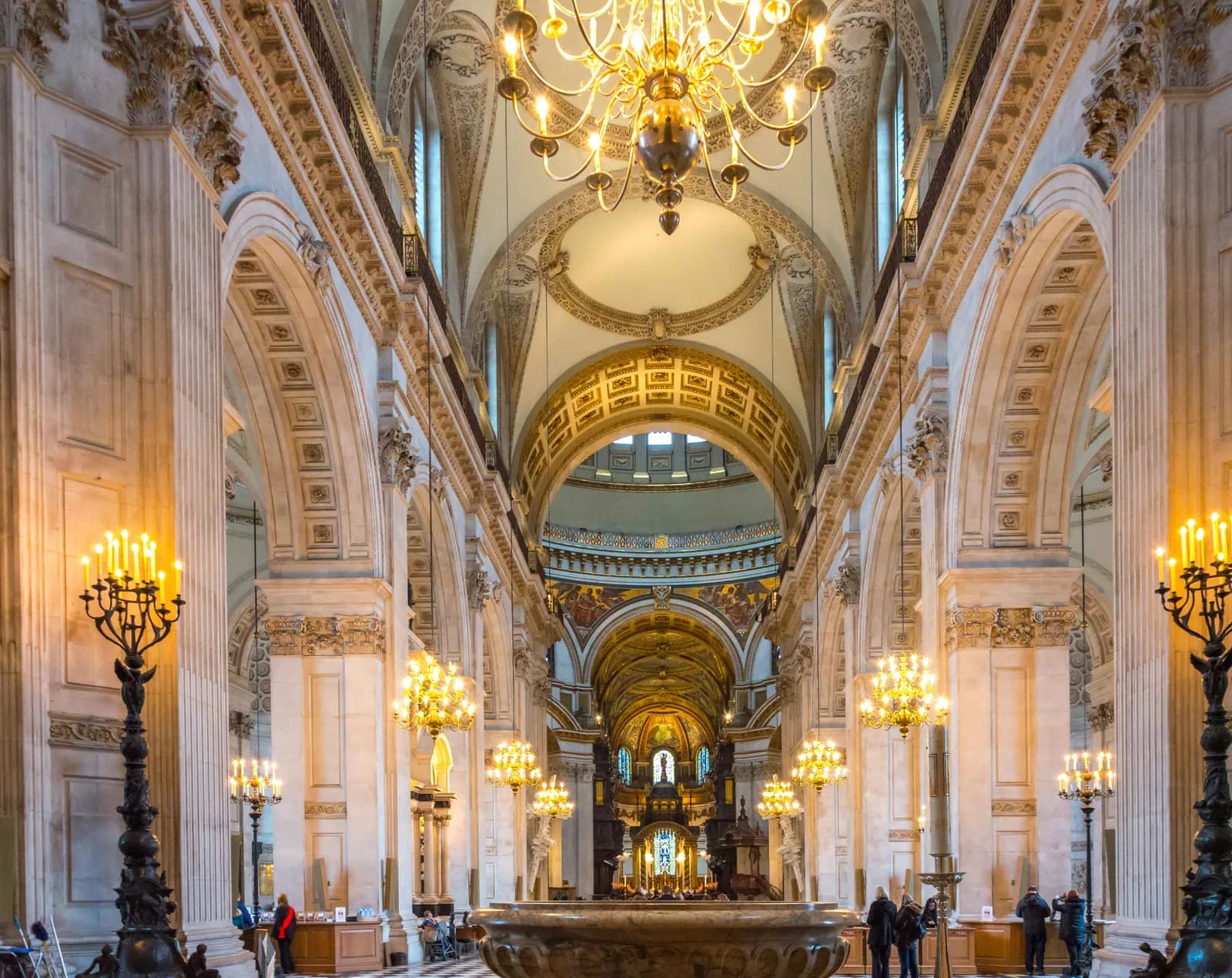
Wren's masterpiece, the new St Paul's Cathedral, would take 35 years to complete. Construction began in 1675, with the building consecrated on 2 December 1697, exactly 31 years and three months after the Great Fire. The final stone was placed on the lantern on 26 October 1708, and Parliament declared the cathedral officially complete on Christmas Day 1711.
The cathedral, built on Ludgate Hill at the City's highest point, measures 518 feet (158 metres) in length and rises to 365 feet (111 metres) at the dome. This height made it the tallest building in London from 1710 until 1963, a record of 253 years. The innovative triple-dome design reflects Wren's scientific training, distributing weight and thrust with engineering precision.
The cost totalled £1,095,556 by 1716, roughly equivalent to £195 million today. Wren was knighted in 1673 during construction, and he lived to see his cathedral finished, dying in 1723 at the age of 90. His tomb in the crypt bears an inscription written by his son: "Reader, if you seek his monument – look around you."
The City of Spires
While St Paul's dominates the skyline, Wren's legacy extends across the Square Mile in the form of churches. His office produced designs for 51 replacement churches, though modern scholars attribute principal creative responsibility for several to his deputies, particularly Nicholas Hawksmoor.
Surviving Wren churches include St Bride's on Fleet Street, St Stephen Walbrook near the Bank of England, St Mary Abchurch in Cannon Street, and St Margaret Pattens in Eastcheap. These buildings established English Baroque architecture in London, combining classical proportions with inventive steeples that punctured the City skyline.
The Blitz of 1940–41 damaged or destroyed many of Wren's churches. Of the original 51, 13 survive intact, nine were substantially rebuilt to Wren's original designs, and six remain as towers only, their naves lost to German bombs. St Dunstan-in-the-East, near the Tower of London, survives as a roofless ruin, its tower and walls converted to a public garden.
Wren's London Today
Londoners encounter Wren's work daily, often unknowingly. The Royal Hospital Chelsea, the Old Royal Naval College at Greenwich, and the south front of Hampton Court Palace all bear his architectural signature. His buildings established a visual language for London's civic architecture that persisted for centuries.
Visitors to the City can follow a self-guided route connecting surviving Wren churches. St Paul's remains open for worship and tourism, accessible from St Paul's Underground station. Many of the smaller churches maintain regular services and welcome visitors during the week, their interiors revealing the craftsmanship that Wren's commissions attracted.
The skyline Wren created, dominated by his cathedral dome surrounded by a cluster of spires, defined London's visual identity for three centuries. Modern towers have altered that view, but from certain vantage points along the Thames or from within the Square Mile, his vision remains discernible; a testament to what emerged from the ashes of 1666.